How to Effectively Interview Caregivers for Home Care: Essential Questions and Hiring Tips
Finding the right in-home caregiver can feel overwhelming when your loved one's comfort and safety are at stake. This guide on how to interview caregivers reveals proven strategies for identifying empathy, reliability, expertise, and legal compliance, so you can make confident hiring decisions. You will learn:
What core qualities define a great home caregiver
The most impactful interview questions to ask
How to build and use a tailored hiring checklist
Legal and tax considerations when bringing a caregiver on board
Cost factors, pricing insights, and financial assistance options
Techniques for assessing personal compatibility
Best practices for structuring honest, productive interviews
Whether you're an adult child exploring in-home senior care or an individual weighing long-term care insurance, these insights empower you to choose compassionate support.
What Are the Key Qualities of a Good Home Caregiver?
A good home caregiver combines empathy with professional skill, ensuring clients feel respected while receiving safe, personalized support. Empathy nurtures trust through active listening and emotional validation, while proficiency in daily living assistance reduces risks and enhances well-being. For example, a caregiver who anticipates mobility needs helps prevent falls and fosters independence.
Essential Qualities of a Good Home Caregiver
A good home caregiver combines empathy with professional skill, ensuring clients feel respected while receiving safe, personalized support. Empathy nurtures trust through active listening and emotional validation, while proficiency in daily living assistance reduces risks and enhances well-being.
This highlights the core attributes needed for effective caregiving, which is crucial for the interview process.
Which personal traits indicate caregiver reliability and compassion?
Caregiver reliability and compassion manifest through consistent punctuality, attentive presence, and genuine concern for the client's dignity.
Punctuality and Dependability: Arriving on time and adhering to schedules demonstrates respect and organizational skill.
Emotional Intelligence: Recognizing subtle signs of distress and offering reassurance builds trust.
Patience and Flexibility: Adapting to unexpected care needs or behavioral changes supports client comfort.
These traits create a supportive environment that transitions naturally into evaluating communication effectiveness in caregiving relationships.
Key Qualities of a Good Home Caregiver
Caregiver reliability and compassion manifest through consistent punctuality, attentive presence, and genuine concern for the client's dignity. These traits create a supportive environment that transitions naturally into evaluating communication effectiveness in caregiving relationships.
This emphasizes the importance of reliability and compassion, which are key aspects to assess during interviews.
How do communication skills impact caregiver effectiveness?
Strong communication skills ensure clarity about care plans, medication schedules, and personal preferences, reducing misunderstandings and stress.
Clear Oral and Written Updates: Concise progress notes and verbal briefings keep families informed.
Active Listening Techniques: Reflecting back concerns confirms understanding and fosters collaboration.
Cultural Sensitivity and Respect: Tailoring language and tone to cultural backgrounds enhances rapport.
When communication is open and precise, coordination with medical professionals and family members becomes seamless, paving the way to verify professional credentials.
Impact of Communication Skills on Caregiver Effectiveness
Strong communication skills ensure clarity about care plans, medication schedules, and personal preferences, reducing misunderstandings and stress. When communication is open and precise, coordination with medical professionals and family members becomes seamless, paving the way to verify professional credentials.
This underscores the significance of communication skills in caregiving, which is essential for effective care.
What experience and certifications should you look for in a caregiver?
Experience in senior care or disability support and formal credentials indicate a caregiver's readiness to handle complex needs effectively.

These credentials demonstrate a caregiver's formal preparation and signal the advanced skill set required to maintain safety and comfort. Reviewing certifications directly informs the design of targeted interview questions.
Experience and Certifications for Caregivers
Experience in senior care or disability support and formal credentials indicate a caregiver's readiness to handle complex needs effectively. These credentials demonstrate a caregiver's formal preparation and signal the advanced skill set required to maintain safety and comfort.
This highlights the importance of experience and certifications, which are important factors to consider when hiring a caregiver.
What Are the Most Important Caregiver Interview Questions to Ask?
Selecting focused questions helps you gauge real-world performance, problem-solving aptitude, and genuine empathy.
How to ask about caregiving experience and specific skills?
Begin with open-ended prompts that invite detailed examples of daily tasks and client scenarios.
"Describe a challenging transfer or mobility situation you've managed and the techniques you used."
"What personal care tasks do you feel most confident performing, and why?"
"How have you assisted clients with medication reminders or health condition monitoring?"
These prompts reveal hands-on experience and allow follow-up on specialized abilities, setting the stage for emergency response inquiries.
What questions reveal a caregiver's problem-solving and emergency response abilities?
Emergency scenarios demand calm judgment and swift action. Ask direct questions that explore past crises and decision-making:
"Can you walk me through a time you handled a sudden medical emergency?"
"What steps do you take if a client falls while you're present?"
"How would you respond if a client refused medication critical to their health?"
Insight into actual problem-solving approaches clarifies readiness to ensure client safety.
Emergency Response Abilities
Emergency scenarios demand calm judgment and swift action. Ask direct questions that explore past crises and decision-making: "Can you walk me through a time you handled a sudden medical emergency?" Insight into actual problem-solving approaches clarifies readiness to ensure client safety.
This emphasizes the importance of assessing a caregiver's ability to handle emergencies, which is a critical aspect of their role.
How to evaluate a caregiver's attitude towards elderly or disabled clients?
Assessing mindset and respect for autonomy reveals long-term compatibility. Request perspectives on client empowerment:
"How do you encourage clients to maintain as much independence as possible?"
"What do you find most rewarding about caring for older adults or individuals with disabilities?"
"How would you address a situation where a client expresses frustration or sadness?"
Understanding their philosophy on dignity and self-determination completes a comprehensive interview before formal screening.
Evaluating a Caregiver's Attitude
Assessing mindset and respect for autonomy reveals long-term compatibility. Request perspectives on client empowerment: "How do you encourage clients to maintain as much independence as possible?" Understanding their philosophy on dignity and self-determination completes a comprehensive interview before formal screening.
This highlights the importance of assessing a caregiver's attitude towards elderly or disabled clients, which is crucial for ensuring compatibility.
How to Use a Hiring In-Home Caregiver Checklist for Effective Screening?
A structured hiring checklist ensures every critical screening step—from credentials to interpersonal alignment—is covered without omissions.
What items should be included in a comprehensive caregiver hiring checklist?
An effective checklist captures personal, professional, and logistical criteria for each candidate.
Verification of identity and legal work authorization
Review of certifications and training validation
Confirmation of health screenings (TB, flu shot)
Completion of criminal background check
Documentation of employment history and reference contact logs
Assessment of availability, shift preferences, and travel obligations
Notes on interpersonal rapport and initial impressions
By systematically reviewing each item, you avoid costly oversights and streamline decision-making. Next, learn how to verify references and background checks using this tool.
Comprehensive Caregiver Hiring Checklist
A structured hiring checklist ensures every critical screening step—from credentials to interpersonal alignment—is covered without omissions. An effective checklist captures personal, professional, and logistical criteria for each candidate.
This emphasizes the importance of using a checklist to ensure a thorough screening process.
How to verify references and background checks using the checklist?
Reference checks and background screenings confirm honesty and past performance. Use the checklist to record:
Reference Contact Details → Dates Called → Feedback Summary
Background Findings → Offense Type (if any) → Resolution Status

Documented feedback ensures transparency and legal compliance, which leads to assessing whether the caregiver aligns with family dynamics.
Reference and Background Check Verification
Reference checks and background screenings confirm honesty and past performance. Documented feedback ensures transparency and legal compliance, which leads to assessing whether the caregiver aligns with family dynamics.
This highlights the importance of verifying references and background checks to ensure a safe and reliable caregiver.
How to assess caregiver compatibility with your family's needs?
Compatibility hinges on matching personality, values, and care style. Evaluate using:
Personality Fit: Shared interests or conversational ease
Cultural and Religious Sensitivity: Respect for traditions and routines
Physical Stamina and Temperament: Ability to adapt energy levels to client needs
Identifying alignment reduces turnover and fosters a harmonious care environment, setting you up for a clear understanding of obligations under the law.
Assessing Caregiver Compatibility
Compatibility hinges on matching personality, values, and care style. Identifying alignment reduces turnover and fosters a harmonious care environment, setting you up for a clear understanding of obligations under the law.
This emphasizes the importance of assessing caregiver compatibility with the family's needs.
What Are the Legal Aspects of Hiring a Home Caregiver?
Understanding contracts, employment laws, and mutual rights protects both parties and ensures ethical compliance.
Legal Aspects of Hiring a Home Caregiver
Understanding contracts, employment laws, and mutual rights protects both parties and ensures ethical compliance. A written service agreement defines expectations, scope of duties, and termination terms.
This highlights the legal aspects of hiring a home caregiver, which is crucial for ensuring ethical compliance.
What contracts and agreements are necessary when hiring a caregiver?
A written service agreement defines expectations, scope of duties, and termination terms. Must-have clauses include:
Scope of Services: Detailed list of tasks and hours
Compensation Terms: Hourly rate, overtime policy, payment schedule
Confidentiality and Privacy: HIPAA compliance for health data
Liability and Insurance: Worker's compensation coverage details
A clear agreement reduces disputes and forms the legal foundation for ongoing care relationships.
How to understand caregiver employment laws and tax responsibilities?
Hiring someone directly classifies you as a household employer, requiring:
Registration for an Employer Identification Number (EIN)
Withholding Social Security and Medicare taxes (FICA)
Reporting wages on Schedule H of Form 1040
Paying state unemployment insurance contributions as applicable
Caregiver Employment Laws and Tax Responsibilities
Hiring someone directly classifies you as a household employer, requiring: Registration for an Employer Identification Number (EIN), Withholding Social Security and Medicare taxes (FICA), Reporting wages on Schedule H of Form 1040, Paying state unemployment insurance contributions as applicable.
This highlights the legal and tax responsibilities of hiring a home caregiver.
What are the rights and protections for both caregiver and employer?
Both parties benefit from transparent policies on sick leave, vacation time, and termination notice. Key protections include:
Fair Labor Standards Act (FLSA) coverage for minimum wage and overtime
Anti-discrimination statutes under the Age Discrimination in Employment Act (ADEA)
Worker's Compensation for job-related injury coverage
Rights and Protections for Caregivers and Employers
Both parties benefit from transparent policies on sick leave, vacation time, and termination notice. Key protections include: Fair Labor Standards Act (FLSA) coverage for minimum wage and overtime, Anti-discrimination statutes under the Age Discrimination in Employment Act (ADEA), Worker's Compensation for job-related injury coverage.
This highlights the rights and protections for both caregivers and employers.
How do caregiver qualifications and service types influence cost?
Higher certifications, specialized dementia training, or medical tasks raise rates by 10–30%. Intensive service types such as overnight monitoring or companionship packages also add to overall expenses. Recognizing these variations helps tailor care plans to budget constraints.
What financial assistance or insurance options can help cover home care costs?
Several resources can offset out-of-pocket expenses:
Long-Term Care Insurance: Reimburses covered services based on policy terms
Veterans Aid & Attendance Benefit: Monthly pensions for eligible veterans and spouses
Medicaid Waivers: State-specific programs funding in-home supports
Life Insurance Conversion: Some policies allow accelerated death benefits for care costs
Financial Assistance Options for Home Care
Several resources can offset out-of-pocket expenses: Long-Term Care Insurance, Veterans Aid & Attendance Benefit, Medicaid Waivers, Life Insurance Conversion.
This highlights the financial assistance options available to help cover home care costs.
How to Evaluate Caregiver Compatibility During the Interview Process?
Assessing personal fit goes beyond credentials to ensure daily interactions feel natural and supportive.
What signs indicate a good personal fit between caregiver and client?
Key indicators include:
Comfort Level: Client relaxes and communicates openly.
Shared Interests: Common hobbies or conversational topics emerge.
Mutual Respect: Caregiver honors client preferences and routines.
Signs of Good Personal Fit
Key indicators include: Comfort Level: Client relaxes and communicates openly, Shared Interests: Common hobbies or conversational topics emerge, Mutual Respect: Caregiver honors client preferences and routines.
This highlights the signs that indicate a good personal fit between caregiver and client.
How to observe caregiver's interpersonal skills and empathy in interviews?
Role-play scenarios and discussion prompts reveal empathy and adaptability:
Simulate a mood-change conversation to see active listening in action.
Ask the caregiver to describe steps for building daily rapport.
Note nonverbal cues such as eye contact, tone warmth, and respectful posture.
Observing Interpersonal Skills and Empathy
Role-play scenarios and discussion prompts reveal empathy and adaptability: Simulate a mood-change conversation to see active listening in action, Ask the caregiver to describe steps for building daily rapport, Note nonverbal cues such as eye contact, tone warmth, and respectful posture.
This highlights the importance of observing a caregiver's interpersonal skills and empathy during interviews.
What follow-up steps ensure the best hiring decision?
A structured follow-up ensures clarity and accountability:
Second Interview with family members or care team
Trial Shift under supervision to confirm real-world compatibility
Final Reference Call to validate any new questions or concerns
Follow-up Steps for Hiring Decisions
A structured follow-up ensures clarity and accountability: Second Interview with family members or care team, Trial Shift under supervision to confirm real-world compatibility, Final Reference Call to validate any new questions or concerns.
This highlights the follow-up steps that ensure the best hiring decision.
What Are Best Practices for Conducting In-Home Caregiver Interviews?
Thoughtful preparation and environment setup help uncover authentic responses and foster trust.
How to prepare for and structure the caregiver interview?
Preparation includes:
Reviewing Candidate Profiles: Note areas for deeper exploration.
Creating a Standardized Question List: Ensures consistency across candidates.
Allocating Dedicated Time: Minimizes interruptions and distractions.
Preparing for and Structuring the Caregiver Interview
Preparation includes: Reviewing Candidate Profiles: Note areas for deeper exploration, Creating a Standardized Question List: Ensures consistency across candidates, Allocating Dedicated Time: Minimizes interruptions and distractions.
This highlights the importance of preparing for and structuring the caregiver interview.
What environment and setting encourage honest caregiver responses?
An informal yet professional atmosphere reduces anxiety:
Conduct interviews in the client's living room or family office for comfort.
Offer refreshments and set clear time expectations.
Encourage open dialogue by emphasizing a conversational tone.
Environment and Setting for Honest Responses
An informal yet professional atmosphere reduces anxiety: Conduct interviews in the client's living room or family office for comfort, Offer refreshments and set clear time expectations, Encourage open dialogue by emphasizing a conversational tone.
This highlights the importance of creating an environment that encourages honest caregiver responses.
How to document and compare caregiver interview results?
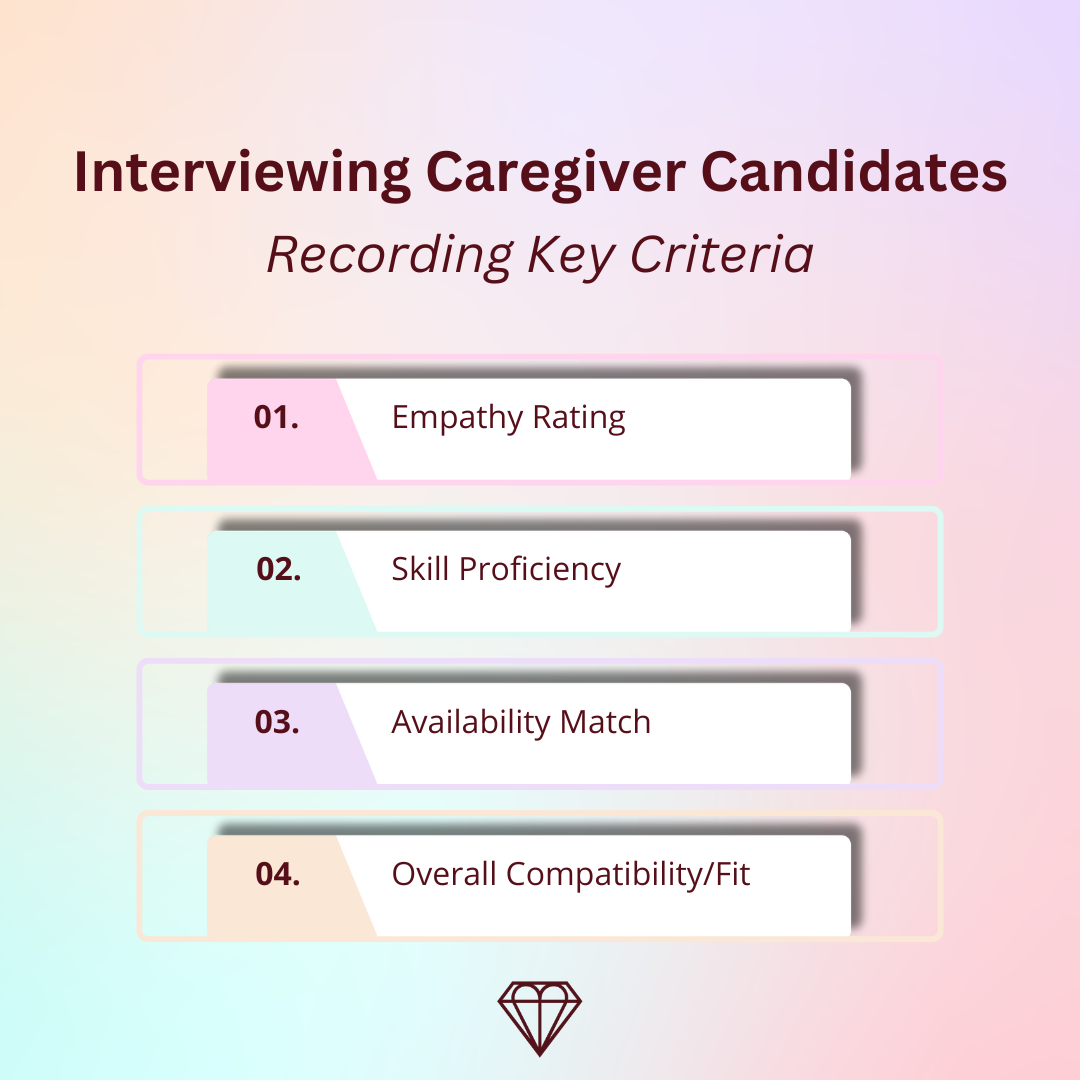
Use a simple comparison matrix to record impressions on key criteria:

Documenting and Comparing Interview Results
Use a simple comparison matrix to record impressions on key criteria: Candidate Name, Empathy Rating, Skill Proficiency, Availability Match, Overall Fit.
This highlights the importance of documenting and comparing caregiver interview results.
A well-executed caregiver interview process ensures your loved one receives skilled, compassionate support tailored to their needs. By focusing on essential qualities, targeted questions, legal compliance, and personal compatibility, you'll confidently welcome a caregiver who promotes independence, safety, and dignity. When you're ready to explore personalized in-home senior care plans or schedule a free assessment, Heritage Senior Care stands ready to guide you through every step with expertise and empathy.